







Live-fire cooking has undergone a remarkable renaissance over the past decade. From the robata grills of Japanese-influenced London restaurants to the open-hearth asado concepts that have spread from Buenos Aires to Sydney, from wood-fired Mediterranean kitchens to the yakitori counters that fill every food hall in Southeast Asia — charcoal has moved from a background utility to a front-of-house statement. It is the heat source that defines the flavour, the theatre, and the identity of some of the most exciting restaurants operating today.
And yet, the procurement of charcoal in most professional kitchens is treated as an afterthought. Head chefs who will spend three hours developing a single sauce specification will accept whatever charcoal arrives from the local cash-and-carry without asking a single question about its grade, its fixed carbon content, or whether it will perform consistently across a 200-cover service. That disconnect — between the importance of charcoal to kitchen performance and the seriousness with which it is typically purchased — is exactly where this guide starts.
If you are responsible for buying bulk charcoal for restaurants — whether for a single site or a multi-location group — this guide will give you the framework to make smarter sourcing decisions, reduce your cost per service, and ensure that the charcoal in your kitchen performs as reliably as every other ingredient on your menu.
Why Charcoal Quality Has a Direct Impact on Kitchen Performance
This is the point that most restaurant buyers miss because they are thinking about charcoal as a commodity rather than an ingredient. Charcoal is the heat source that interacts with protein, fat, and moisture at the grill surface. Its combustion temperature, the consistency of that temperature across the cooking surface, the ash it produces, the smoke compounds it releases — all of these directly influence the flavour and texture of the food coming off your grill.
A charcoal that burns inconsistently — hot at the edges and cool in the centre, or spiking in temperature and then dropping — makes it impossible to achieve repeatable cook times and plate temperatures. A high-ash charcoal creates residue that transfers onto food and into smoke, affecting flavour in ways that are subtle but cumulative across a service. A charcoal that dies out after 90 minutes in a kitchen running a four-hour double service means constant re-loading, labour interruption, and temperature instability at exactly the moments when the kitchen is busiest.
Chef’s Note: The single most useful question a head chef can ask about their current charcoal: “Is every piece from this batch burning at the same rate?” If the answer is no — if some pieces burn bright and fast while others barely ignite — the problem is almost certainly inconsistent fixed carbon content, which is a direct result of poor quality control in the carbonisation process. The fix is a better charcoal supplier, not a better charcoal technique.
Understanding the Charcoal Specifications That Matter to Professional Kitchens
Charcoal is sold by weight, but it performs by specification. Before you make any procurement decision, you need to understand the four numbers that predict whether a charcoal will work in your kitchen:
Fixed Carbon Content
Fixed carbon is the percentage of pure carbon remaining after moisture and volatile compounds are driven off during carbonisation. It is the primary predictor of heat output and burn consistency. A charcoal with fixed carbon of 75–80% or higher (A-Grade) burns hotter, more evenly, and more predictably than a charcoal at 65–70%. For a precision-cooking kitchen — a steakhouse, a Japanese robata counter, a high-end live-fire concept — fixed carbon is the specification that matters most.
Ash Content
Ash content is the percentage of non-combustible mineral matter that remains after the charcoal burns. Low-ash charcoal (≤8% for A-Grade) means less grill maintenance, cleaner cooking surfaces, and reduced risk of ash transfer onto food. High-ash charcoal (16%+ for C-Grade) creates operational friction — more frequent cleaning, greater risk of ash flavour contamination, and a messier working environment.
Moisture Content
Moisture content affects ignition time and burn consistency. Professional-grade charcoal should have moisture content below 6%. High-moisture charcoal takes longer to ignite, produces more smoke during lighting, and burns less efficiently. It also has a higher effective cost per kg of heat output because a proportion of the weight you are buying is water, not fuel.
Burn Time
Burn time is the direct operational metric: how long does one load of charcoal sustain cooking temperature before it needs to be refreshed? A-Grade charcoal from a quality manufacturer delivers 6–8 hours of sustained heat. B-Grade typically delivers 4–6 hours. C-Grade is shorter and less predictable. For a restaurant running a double service — lunch and dinner — A-Grade charcoal on a single load is operationally possible. B-Grade will require a mid-service reload, which means a temperature dip at a critical moment.
Matching Charcoal Type to Your Cooking Style
Different cooking applications require different charcoal characteristics. Choosing the right product for your specific kitchen operation is as important as choosing the right grade.
High-Heat Grilling: Steakhouses, Teppanyaki, Korean BBQ
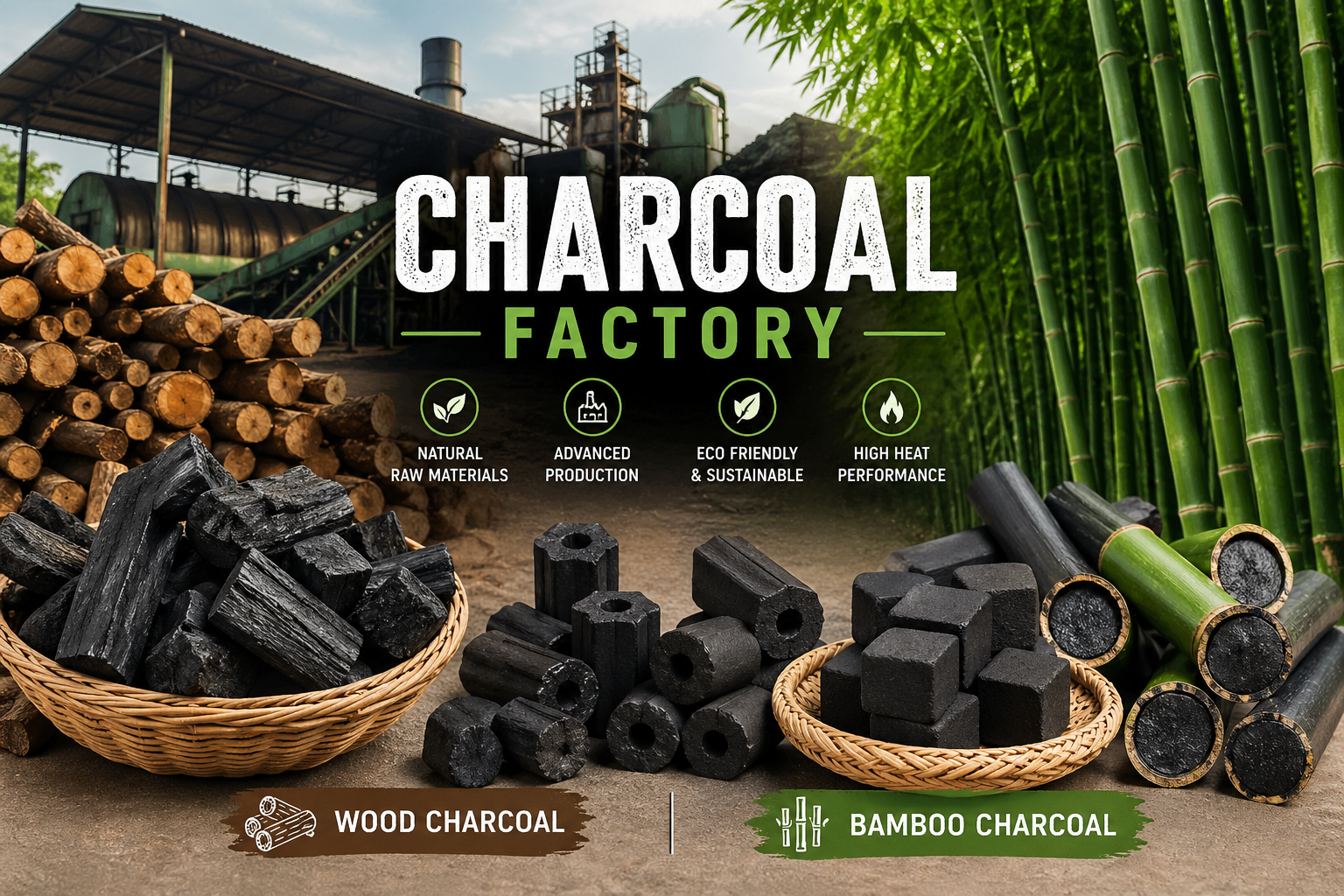
Operations where peak heat and speed are the priorities need a dense, high-carbon charcoal that reaches grilling temperature quickly and maintains it under the load of continuous protein cooking. Machine-made A-Grade bamboo charcoal in hexagonal rod format is the optimal specification: consistent density, fast heat build, minimal ash drop during service, and a burn profile that holds temperature even under high cooking load.
Long, Slow Cooking: BBQ, Smoking, Rotisserie
Low-and-slow cooking applications prioritise sustained, moderate heat over long periods — 4, 6, even 12 hours for competition-style BBQ. B-Grade charcoal is typically more appropriate here: the slightly lower fixed carbon and higher ash content are less critical when heat management is at lower temperatures, and the cost saving versus A-Grade is meaningful when you are consuming large quantities per cook. Shaped wood charcoal or blended bamboo-hardwood product can also add aromatic value in smoking applications.
Yakitori, Robata, and Japanese-Style Grilling
Japanese charcoal grilling traditions demand a highly specific product: dense, clean-burning, low-smoke, with minimal aroma interference so the natural flavour of the protein and tare glaze remains uncontaminated. A-Grade machine-made bamboo charcoal — particularly high-temperature bamboo carbonised above 900°C — is the professional standard for these applications. The investment in premium charcoal is non-negotiable for authenticity-focused concepts in this category.
Restaurants with Shisha or Hookah Lounge Areas
A growing number of restaurants — particularly Middle Eastern, North African, and specialist hospitality concepts — operate both a kitchen and a shisha lounge within the same venue. Attempting to use cooking charcoal for shisha service, or vice versa, creates operational and quality problems on both sides. The right approach is to source cooking charcoal and wholesale hookah charcoal from the same manufacturer, combine them in a single container order, and benefit from combined volume pricing across both product lines.
The True Cost of Charcoal per Service: A Calculation Every Kitchen Buyer Needs to Do
Most restaurant buyers compare charcoal on price per kilogram. This is the wrong metric. The right metric is cost per service — how much it costs in charcoal to run your grill through one complete cooking session. This calculation changes the economics of quality charcoal entirely.
Here is a worked example comparing B-Grade and A-Grade charcoal for a restaurant running a single dinner service:
B-Grade Scenario: Price: €2.20/kg. Burn time: 4–5 hours. Consumption per service: 6 kg (reload required mid-service). Cost per service: €13.20. Labour interruption for mid-service reload: yes.
A-Grade Scenario: Price: €2.80/kg. Burn time: 6–8 hours. Consumption per service: 4 kg (no reload required). Cost per service: €11.20. Labour interruption: none.
A-Grade costs €0.60/kg more but delivers €2.00 lower cost per service and eliminates one mid-service reload per dinner sitting. Over 250 service days per year, that difference adds up to €500 in direct cost savings and 250 fewer grill management interruptions for the kitchen team. The “cheaper” charcoal is actually more expensive in operation.
Buyer’s Alert: This calculation only holds if you are sourcing A-Grade charcoal at direct-from-factory pricing. If you are buying A-Grade through a distributor or local wholesaler, the per-kg cost may be high enough to negate the per-service saving. The case for quality charcoal and the case for direct sourcing are the same argument — they only work together.
How Restaurant Groups Should Structure Their Charcoal Procurement
Single-Site Restaurants: 2,000–6,000 kg per Year
For individual restaurants consuming up to 6,000 kg per year, the most efficient procurement model is a monthly standing order with a regional distributor who sources direct from a manufacturer. This delivers consistent specification, regular delivery, and no requirement to manage your own import logistics. Ask your distributor specifically whether they source from a direct manufacturer and request documentation — a Certificate of Analysis — for the product they are supplying.
Multi-Site Restaurant Groups: 10,000–50,000 kg per Year
Restaurant groups consuming 10,000 kg or more annually should be evaluating direct container sourcing from a manufacturer. At this volume, the per-kg cost saving from eliminating distributor margins is substantial — typically 20–35% — and the logistical complexity of managing a container import is entirely manageable with basic freight forwarding support.
A group at this scale should be working with a genuine charcoal distributor and supplier manufacturing partner — not a broker — with full export documentation, locked specifications, and a dedicated account contact who understands the operational requirements of a professional kitchen supply chain.
Catering Companies and Event Operations
Catering businesses and event operators have variable, often seasonal charcoal requirements that do not fit neatly into monthly standing orders or full container buying. The most efficient model for this segment is a relationship with a regional distributor who can flex volumes across a season, ideally one who sources from the same manufacturer as the restaurant group accounts — which means consistent product specification even at smaller, more variable order quantities.
What to Ask Your Charcoal Supplier Before Placing a Restaurant Order
The quality of your charcoal is only as reliable as the quality of your supplier relationship. These are the questions that will tell you whether you are talking to a serious professional or a commodity reseller:
1. Can you provide a Certificate of Analysis for the batch I will receive, showing fixed carbon, ash, and moisture content?
2. What is your lead time for a standard reorder, and what is the process if a delivery arrives off-specification?
3. Is the product I am buying produced by you directly, or sourced from a third-party supplier?
4. What packaging formats are available — 10kg master cartons, 20kg master cartons — and can you accommodate a delivery schedule that matches my service cycle?
5. Do you offer fixed annual pricing, or will my cost fluctuate with spot market conditions?
6. What certifications does the product carry — food-grade, phytosanitary, halal?
A supplier who cannot answer these questions clearly and quickly is not a supplier who will be reliable when your kitchen needs them most.
Sustainability and Sourcing: An Increasingly Important Consideration for Restaurant Operators
Sustainability credentials for restaurant heat sources are increasingly relevant to press coverage, customer perception, and in some markets, regulatory compliance. Natural bamboo charcoal — produced from a fast-growing renewable resource, carbonised without chemical additives, and shipped with full phytosanitary documentation — has a significantly better environmental profile than fossil-derived briquettes or wood charcoal sourced from non-certified timber.
For restaurants with environmental commitments or sustainability messaging, this is not a marginal point. Bamboo regenerates within 3–5 years without replanting. It sequesters carbon during growth. It produces no chemical by-products during combustion. These are facts that can be communicated to customers, included in menu copy, and incorporated into your broader sustainability reporting — all from a sourcing decision that also improves kitchen performance and reduces cost per service.
Retailers and distributors sourcing wholesale BBQ charcoal for restaurant supply chains can also benefit from this narrative — particularly when pitching to premium restaurant groups where sustainability is part of the procurement criteria.
Final Thoughts: Professional Kitchens Deserve Professional Charcoal Sourcing
A live-fire kitchen is only as good as the fuel it runs on. The head chefs who consistently produce outstanding charcoal-cooked food do so because they have taken the time to understand their heat source — what grade it is, where it comes from, how it will behave under service load — with the same rigour they apply to every other input in the kitchen.
The procurement side of that equation is equally important. Sourcing bulk charcoal for restaurants directly from a verified manufacturer, with documented specifications and fixed pricing, gives your kitchen team the reliable foundation they need to produce consistent food at every service. That consistency is not just a culinary achievement — it is a commercial one.
Start with the right charcoal. Work with a manufacturer who takes quality control as seriously as you take your cooking. And treat your fuel specification with the same discipline you bring to everything else on your menu.
Source bulk restaurant charcoal direct from the manufacturer — request a quote today: thecharcoalfactory.com/bulk-charcoal-for-restaurants